
 Site • RSS • Apple Podcasts
Description (podcaster-provided):
The Beyond Podcast explores meta-topics and concepts. Note: this has nothing to do with Meta - the corporation. We will focus on mind-twisting subjects like recursion, self-similarity, self-reference, various paradoxes, and other fun puzzles and problems. We will discuss meta references in art and entertainment. And we will try to make these discussions fun and entertaining! Check out The Beyond Podcast at thebeyondpod.com, or wherever you get your podcasts.Themes and summary (AI-generated based on podcaster-provided show and episode descriptions):
➤ metatopics: recursion, self-reference, paradoxes, strange loops • computation theory: Turing machines, halting problem, fixed points, quines • information/complexity: Kolmogorov complexity, minimal descriptions • probability/epistemology • meta in physics, maps, security exploits • sci-fi/puzzle book discussionsThis podcast explores “meta” ideas: systems that describe, reference, or reproduce themselves, and the puzzles and paradoxes that arise from self-reference, recursion, and strange loops. Across episodes, discussions draw from mathematics, computer science, philosophy, and physics to examine how knowledge and meaning behave when a framework tries to talk about itself.
A recurring thread is theoretical computing and logic, including Turing machines, the Halting Problem, fixed-point reasoning, and Gödel-style limits on what formal systems can prove. Related topics such as quines, cellular automata, algorithms, and ways of naming extremely large numbers are used to connect abstract theory to the capabilities and constraints of programming languages and machines.
The show also leans into information and description: how compactly a string can be specified, what it means for a text to be “found” within a larger sequence, and how concepts like Kolmogorov complexity shape intuitions about randomness and structure. Probability and epistemology appear through thought experiments about sampling assumptions and inference under uncertainty.
Another theme is “metaness” in broader contexts—maps and coordination points, security and “jumping out of the system” via exploits, and speculative technology such as self-replicating probes—often tying these ideas to science fiction and puzzle literature. Along the way, the podcast references and discusses novels and short fiction that echo these self-referential concepts, using them as additional lenses on the same underlying themes.
| Episodes: |
|
This Episode Was Randomly Selected From The Set Of All Possible Episodes 2026-Jan-03 32 minutes |
|
This Episode Halts 2025-Sep-19 36 minutes |
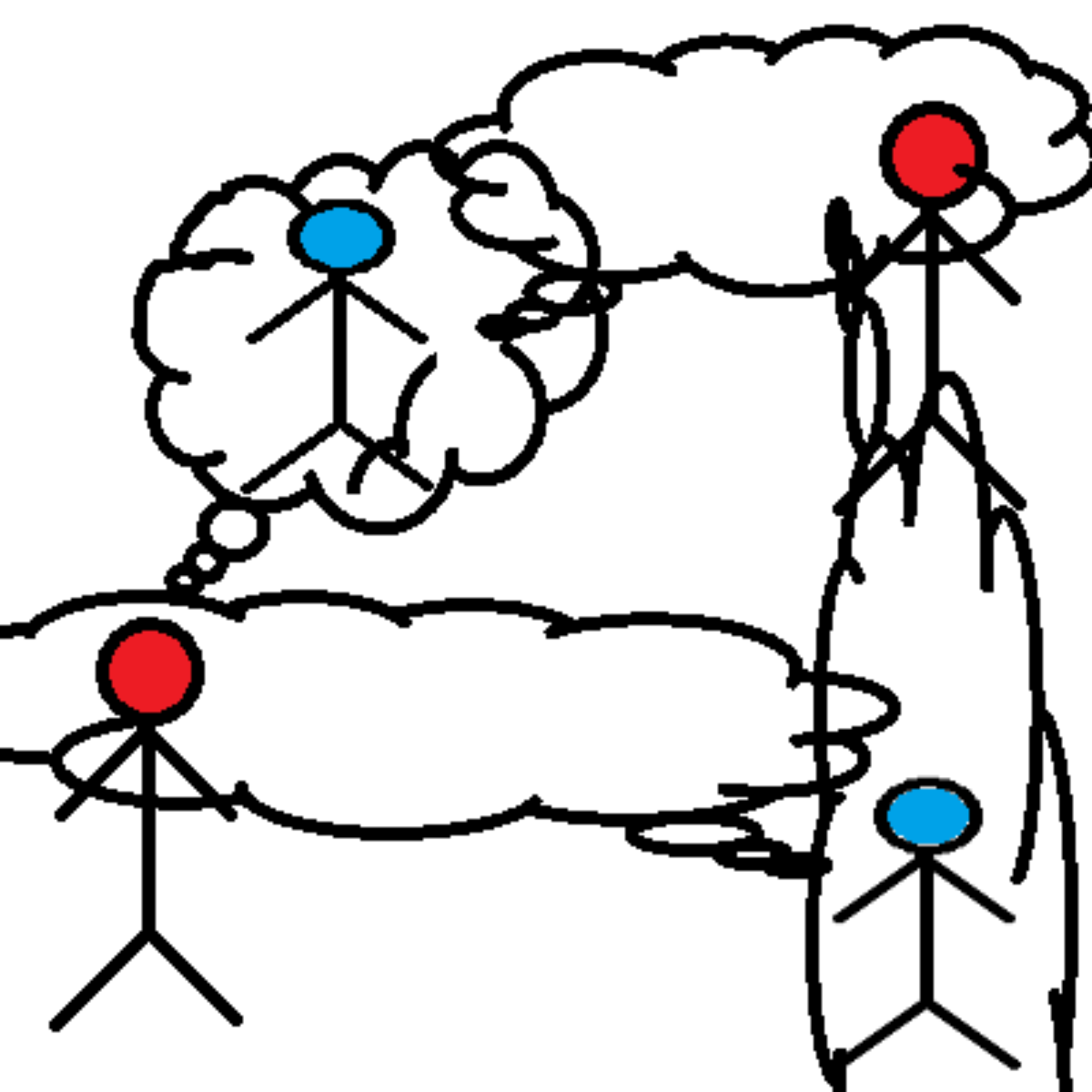 This Episode’s Ontogeny Recapitulates Phylogeny
2025-Jul-08 34 minutes |
|
This Episode’s Title Exists Somewhere In the Digits of Pi 2025-Apr-14 30 minutes |
|
This Episode Cannot Prove Its Own Consistency 2024-Jun-02 36 minutes |
|
This Episode’s Title Has Thirty Eight Letters 2024-Jan-29 30 minutes |
|
This Episode Contains The Seeds Of Its Own Creation 2023-May-22 32 minutes |
|
This Episode Is Coming From Inside Your Headphones 2023-Mar-13 38 minutes |
|
The Following Episode Is False 2023-Jan-03 32 minutes |
|
This Episode Contains a Hapax Legomenon 2022-Dec-05 37 minutes |
|
This Episode’s Transcript is a 89742 Byte PDF Document 2022-Nov-13 35 minutes |
|
This Episode is 2580 Seconds Long 2022-Oct-30 43 minutes |
 This Episode Has 6650 Words
2022-Oct-21 44 minutes |