
 Site • RSS • Apple Podcasts
Description (podcaster-provided):
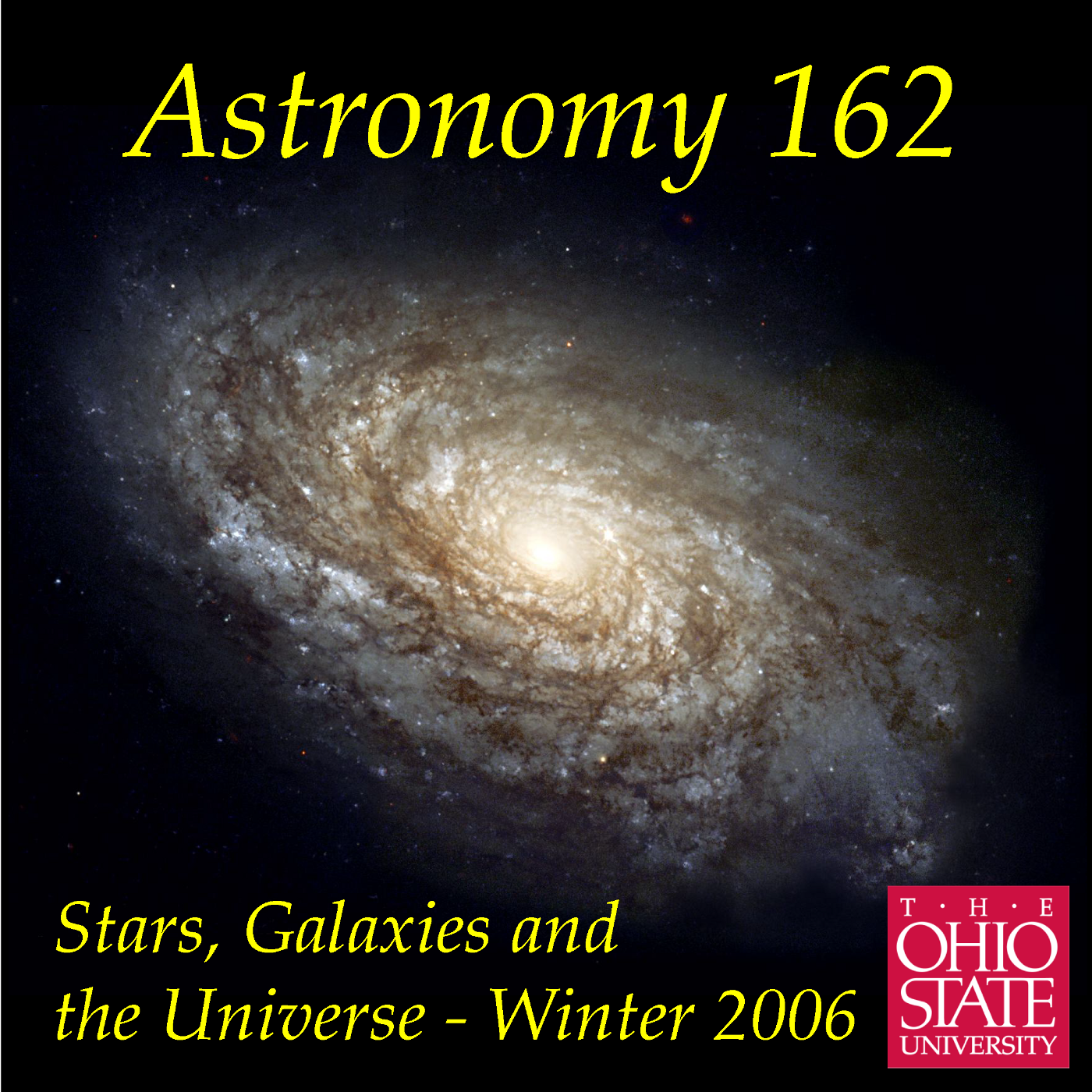
Astronomy 162, Stars, Galaxies, and the Universe, is part 2 of aThemes and summary (AI-generated based on podcaster-provided show and episode descriptions):
➤ Intro astronomy lectures • stellar properties and measurement (parallax, spectra, H‑R diagram) • stellar structure, fusion, energy transport • star formation and evolution • supernovae, remnants, black holes • Milky Way, galaxies, AGN/quasars • relativity, expansion, Big Bang, dark matter/energy • astrobiology, SETIThis podcast is a set of recorded university lectures from an introductory astronomy course for non-science majors, focused on how astronomers observe, measure, and explain stars, galaxies, and the universe as a whole. It begins with the practical foundations of stellar astronomy: determining distances with parallax and other “standard candle” techniques, measuring stellar motions with proper motion and Doppler shifts, and quantifying brightness through luminosity, magnitudes, and photometry. From there, it develops the tools used to infer stellar properties such as mass, radius, temperature, and composition, including binary-star methods and spectral classification, culminating in the Hertzsprung–Russell diagram as a framework linking observable traits to stellar physics.
A major theme is stellar structure and evolution. The lectures outline hydrostatic and thermal equilibrium, energy generation via gravitational contraction and nuclear fusion, and energy transport by radiation and convection. They trace how stars form from molecular clouds, how mass governs main-sequence lifetimes, and how low- and high-mass stars end their lives, including red giant and supergiant phases, planetary nebulae, white dwarfs, core-collapse supernovae, neutron stars, pulsars, and black holes. Observational tests using star clusters and their H–R diagrams connect theory to data.
The scope then expands to galactic astronomy and cosmology: the structure of the Milky Way, the discovery of external galaxies, galaxy types and classification, rotations and mass measurements, groups and clusters, mergers and interactions, and active galactic nuclei powered by accreting supermassive black holes. Finally, the course turns to relativity and the expanding universe, covering Hubble’s law, the cosmic distance ladder, the Big Bang and its evidence (light-element abundances and the cosmic microwave background), the universe’s fate, dark matter and dark energy, and a concluding discussion of life in the universe and SETI.
| Episodes: |
|
Welcome to Astronomy 162 2006-Mar-10 |
|
Lectures 1-4: An Explanation 2006-Nov-27 |
|
Lecture 05: Distances of the Stars 2006-Jan-09 |
|
Lecture 06: The Motions of the Stars 2006-Jan-10 |
|
Lecture 07: Stellar Brightness 2006-Jan-11 |
|
Lecture 08: Stellar Masses & Radii 2006-Jan-12 |
|
Lecture 09: Stellar Spectra 2006-Jan-13 |
|
Lecture 10: Synthesis: The Herzsprung-Russell Diagram 2006-Jan-17 |
|
Lecture 11: The Internal Structure of Stars 2006-Jan-18 |
|
Lecture 12: As Long as the Sun Shines 2006-Jan-19 |
|
Lecture 13: Energy Generation and Transport in Stars 2006-Jan-23 |
|
Lecture 14: Star Formation 2006-Jan-24 |
|
Lecture 15: The Main Sequence 2006-Jan-25 |
|
Lecture 16: The Evolution of Low-Mass Stars 2006-Jan-26 |
|
Lecture 17: The Evolution of High-Mass Stars 2006-Jan-27 |
|
Lecture 18: Supernovae 2006-Jan-30 |
|
Lecture 19: Extreme Stars: White Dwarfs & Neutron Stars 2006-Jan-31 |
|
Lecture 20: Black Holes 2006-Feb-01 |
|
Lecture 21: Testing Stellar Evolution 2006-Feb-02 |
|
Lecture 22: The Cosmic Distance Problem 2006-Feb-06 |
|
Lecture 23: The Milky Way 2006-Feb-07 |
|
Lecture 24: The Realm of the Nebulae 2006-Feb-08 |
|
Lecture 25: A Tale of Two Galaxies, The Milky Way and Andromeda 2006-Feb-09 |
|
Lecture 26: Spiral Galaxies 2006-Feb-10 |
|
Lecture 27: Spirals, Ellipticals, & Irregular (Oh My!) 2006-Feb-13 |
|
Lecture 28: Groups & Clusters of Galaxies 2006-Feb-14 |
|
Lecture 29: When Galaxies Collide 2006-Feb-15 |
|
Lecture 30: Active Galaxies & Quasars 2006-Feb-16 |
|
Lecture 31: A Tale of Two World Views: Special Relativity 2006-Feb-20 |
|
Lecture 32: Space, Time, & Gravity: General Relativity 2006-Feb-21 |
|
Lecture 33: Einstein's Universe 2006-Feb-22 |
|
Lecture 34: The Expanding Universe 2006-Feb-23 |
|
Lecture 35: The Cosmic Distance Scale 2006-Feb-24 |
|
Lecture 36: The Big Bang 2006-Feb-27 |
|
Lecture 37: The Whispers of Creation 2006-Feb-28 |
|
Lecture 38: The First Three Minutes 2006-Mar-01 |
|
Lecture 39: The Fate of the Universe 2006-Mar-02 |
|
Lecture 40: The Once and Future Sun 2006-Mar-06 |
|
Lecture 41: Dark Matter & Dark Energy 2006-Mar-07 |
|
Lecture 42: Time Travel 2006-Mar-08 |
|
Lecture 43: Life in the Universe, Part I 2006-Mar-09 |
|
Lecture 44: Life, the Universe, and Everything (Life Part II) 2006-Mar-10 |
|
Astronomy 141 Podcast Teaser 2009-Dec-06 |